The South Wopmay Project combines traditional bedrock mapping with focused investigations, such as metallogenic, isotopic, magnetotelluric, and geophysical studies. Bedrock mapping is focused in a narrow corridor that encompasses many of the major tectonic elements of the Wopmay Orogen (NTS 86B/4 and 5 and 86C/1 to 8). This corridor is positioned to maximize the benefits of magnetotelluric and teleseismic data, which will characterize the lower crust / lithospheric mantle to the west of the exposed Slave Province (Western Slave Study).

There are two phases of mapping for the South Wopmay Project. Fieldwork for Phase I was initiated in 2004 and completed in 2007; results from this work are summarized below. Phase II got underway in the summer of 2008 and results will be posted on this site and presented at the Yellowknife Geoscience Forum in November of each year.
|
|
|
Aerial view of the northeast end of Castor Lake, early June, 2006.
|
|
|
|
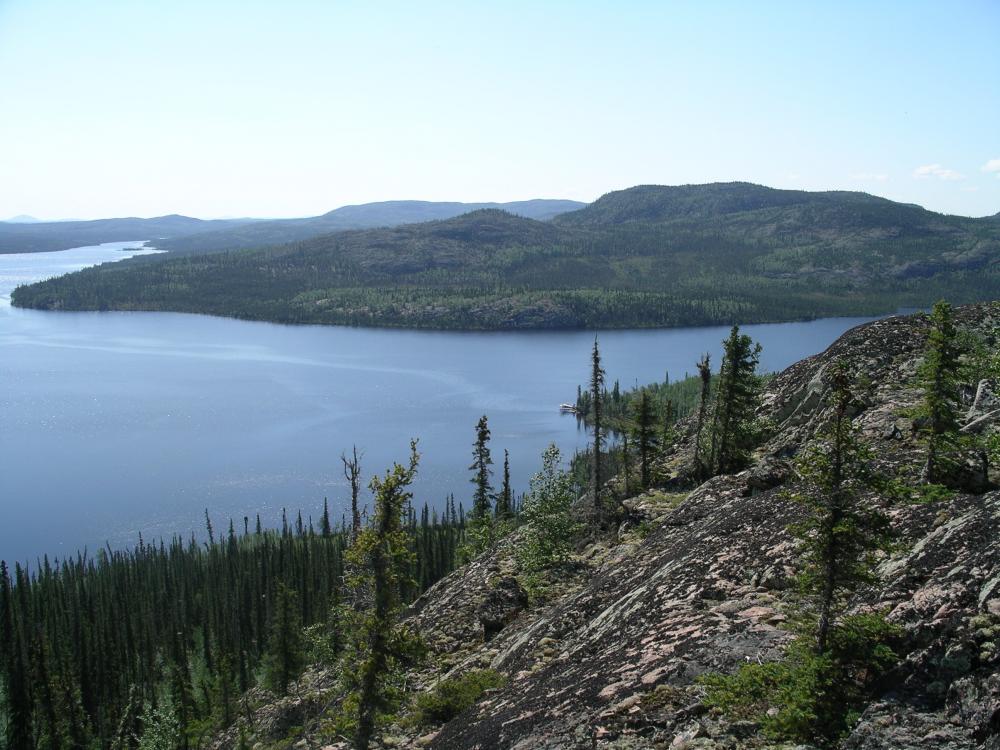
View from August 2006 camp on Hardisty Lake.
|
|
|
|
|
|
|
|
 |
 |
|
Overlooking Great Bear magmatic Zone
|
Aerial view of folds at Mattberry Lake
|
|
|
|
Rocks of the Slave Province are exposed east of Mattberry Lake. West of Mattberry Lake and extending almost to the Wopmay fault zone is the ‘Mattberry granite’, which intrudes schistose and migmatitic rocks of the Archean Yellowknife Supergroup. Collectively these rocks form basement to the Paleoproterozoic Snare Group. The unconformity between the Snare Group strata and these basement rocks is well exposed at Mattberry Lake. At low metamorphic grade the Snare Group consists of sandstone, siltstone, mudstone, quartz pebble conglomerate, limestone, and locally stromatolitic dolomite. Primary sedimentary structures are well preserved. The metamorphic grade of the Snare Group rocks increases to the west and north; from greenschist grade at Mattberry Lake, to garnetiferous schist and tremolite-bearing marble at Ingray Lake, and amphibolite-grade migmatitic and gneissic rocks at “Arm” Lake. At Ingray and “Arm” lakes Snare Group sedimentary rocks are locally interlayered with mafic plutonic and possible volcanic rocks. This interlayered sequence contains extensive gossans, which have affinities with volcanic-hosted or exhalative styles of mineralization.
|
|
|
Folded unconformity between Snare Group sandstone and Mattberry granite.
|
|
|
|
Quartz pebble conglomerate within Snare Group.
|
|
|
|
Load structures within Snare Group.
|
|
|
|
|
|
|
Pyrite seam in gossan at Ingray Lake.
|
|
|
|
Intraformational carbonate breccia with stromatolites, Snare Group.
|
|
|
West of Wopmay fault zone, the biotite-magnetite ± hornblende-bearing rocks of the Great Bear magmatic zone are divisible into medium- to coarse-grained plutonic phases, fine-grained hypabyssal rhyolitic to dacitic porphyries and probable volcanic rocks (Faber Group?). Two relative ages of porphyry are recognized; older, foliated pre-granite emplacement porphyry is exposed near DeVries Lake and younger, isotropic post-granite intrusion porphyry is found in the ‘Fab’ Lake area. Preserved within these rocks are magnetite-rich schist, migmatite and gneiss that are tentatively correlated with the Treasure Lake Group sedimentary sequence. These rocks are well exposed at DeVries Lake, where they have undergone pervasive potassic, sodic, calcic and magnetite alteration that is similar to alteration observed in iron-oxide-copper-gold mineralizing systems. Previous work by Gandhi and Prasad (1993; Geological Survey of Canada, Current Research, Paper 93-1C, p. 29-39) documented several multi-element mineral showings at DeVries Lake
.Phase I mapping has uncovered several new mineral occurrences; east of Wopmay fault zone these include Cu and Mn, while west of the fault zone combinations of Cu, W, Co, Ag, Au, and U were found.
|
|
|
Rapakivi granite, DeVries Lake.
|
|
|
|
Na-alteration of pink porphyry.
|
|
|
|
Migmatitic rocks of the Treasure Lake Group.
|
|
|
|
|
Extensive Na and Ca alteration in rocks of Treasure Lake Group affinity.
|
|
|
|
Cu showing from 2005 mapping.
|
|
|
|
Altered pyroclastic(?) rock.
|
|
|
The South Wopmay
project continues to support undergraduate and graduate level theses, which address key questions identified within the study area and beyond. A Master’s thesis is underway at the University of Alberta to examine the characteristics of giant quartz veins, which are mainly found within the Great Bear magmatic zone. A post-doctoral study at Memorial University of Newfoundland is aimed at characterizing the magmatic source areas for plutonic and volcanic rocks and providing age constraints on the major tectonic and magmatic events. Preliminary results from theses studies, economic, geochemical and isotopic investigations, and the POLARIS seismic experiment were presented at the Yellowknife Geoscience Forum in November 2006 (see: Azar et al., Bennett and Rivers, Bennett et al., Byron et al., Corriveau and Mumin, Sandeman et al., Steeves et al., and Sutherland et al., 2006 GSF abstracts).
Results from studies carried out in 2005 were presented at the Yellowknife Geoscience Forum in November 2005 (see: Bruneton and Snyder, Brzozowski et al., Corriveau and Mumin, Goff and Ootes, Landry et al., and Moroskat et al., and Snyder, et al. 2005 GSF abstracts). In 2004, a B.Sc. thesis at Carleton University examined the geology and geochemistry of the various mafic dykes in the project area (Stoffers, 2005), and preliminary results from the magnetotelluric survey were presented at the Yellowknife Geoscience Forum in November 2004 (Spratt, J. et al. 2004 GSF abstract). Assay results are reported in Ootes et al., 2006 and 2008 (NWT Open Report 2006-002, NWT Open Report 2008-008). Results from the bedrock-mapping project have been presented annually at this forum (see: Jackson et al., 2004, 2005 and 2006 GSF abstracts) as well as in map and report format (see Jackson, 2006 NWT Open Report 2006-004 and Jackson, 2005 NWT Open Report 2005-002).
|
|
|
2006 mapping crew and guests.
|
|
|
|
|
|
|
|
In memory of Kimber, faithful field assistant and camp guardian for almost 14 years.
|
|
|
|
|